Showing posts with label Egypt. Show all posts

Saturday, 10 March 2012

Egyptian Culture in France

France conquered Egypt between 1798 and 1801. During that period, France's greatest military leader, Napolean Bonaparte became extremely fascinated with the wonders of Egypt that he ordered various scholars to study its treasures. Their extensive research resulted in a series of publication called Description de l'Egypte (English translation: Description of Egypt).

Napolean's discoveries in Egypt gave rise to a fascination for ancient Egyptian culture and the birth of Egyptology in Europe. This is probably why I saw a few Egyptian culture in France like this statue in Versailles:

This statue has a fusion flavour to it - top part is decked in Egyptian regalia, whereas the bottom part is dressed like a Greek goddess. I almost missed this statue because it's small.


And this obelisk in Place de la Concorde, Paris:

Night shots are difficult to snap as they turn out blurred most of the time. Luckily you can still see that this is an obelisk :P


But the most obvious Egyptian influence in France would probably be the popular glass pyramid at The Louvre Museum:

The glass pyramid at The Louvre has also become popular due to Dan Brown's best selling novel, The Da Vinci Code.


The next time you visit France, watch out and see if you can spot any more Egyptian culture. They may be right in front of your eyes like the glass pyramid at The Louvre, or hidden in a corner like that small statue in Versailles.


Wednesday, 30 March 2011

The Great Temple of Abu Simbel and the Festival of the Sun

If you're fascinated at the grandeur of this temple in Egypt, wait till you hear what takes place within its walls twice a year.

The Great Temple of Abu Simbel or Sun Temple of Ramses II was built in dedication to Ramses II, as well as the gods Amon Ra, Harmakhis and Ptah.

Ramses II was one of the most famous pharaohs. He ruled Egypt from 1304 – 1237 BC (different sources state different time frames) and is regarded as the greatest and most powerful pharaoh of the Egyptian empire. Ramses II is also known as Ramses the Great.

Four gigantic statues of Ramses II, each more than 20 metres tall guard the entrance of the temple. It is intended that the statues unblinking stare would be the first thing that visitors, travelers and especially enemies see when they enter Egypt from the south.


The Festival of the Sun or Coronation of Ramses II falls on 22 February (Ramses II’s birthday) and 22 October (his coronation day) annually.

I was lucky to visit Egypt in February 2008 during the festival. So I travelled south to Aswan to witness this sunlight phenomena.

As I made my way inside the temple, I looked up and gasped at the sight of these statues.


So what happens during the festival?

In the most sacred part of the temple lies the statue of Ramses II, together with that of Amon Ra, Harmakhis and Ptah. This part of the temple is shrouded in darkness throughout the year.

However, twice a year on 22 February and 22 October, sunlight penetrates the entire length of the temple and floods the statues of Ramses II, Amon and Harmakhis. After about 5 minutes the light disappears.

What makes it interesting is that the statue of Ptah is never hit by the sunlight because Ptah is the god of darkness. Cool, huh?!

This is one of the reasons thousands of tourist flock to this magnificent temple to witness this phenomena. Sorry no pics to show you cause photography is not allowed inside the temple.

A temple dedicated to Nefertiti, Ramses II's wife is located beside Abu Simbel. Nothing beats looking at these 2 marvels of ancient architecture with your own eyes. The feeling of owe and wonder never seizes to amaze me.


A = Cairo, B = Aswan, C = The Great Temple of Abu Simbel


The Great Temple of Abu Simbel is located beside Lake Nasser. Its rising waters used to threaten the temple. What happened next became one of the greatest stories in archeological history, which I'll tell you about in my next entry.


Friday, 16 July 2010

The Mystery of the Egyptian Cross and the Logan Memorial

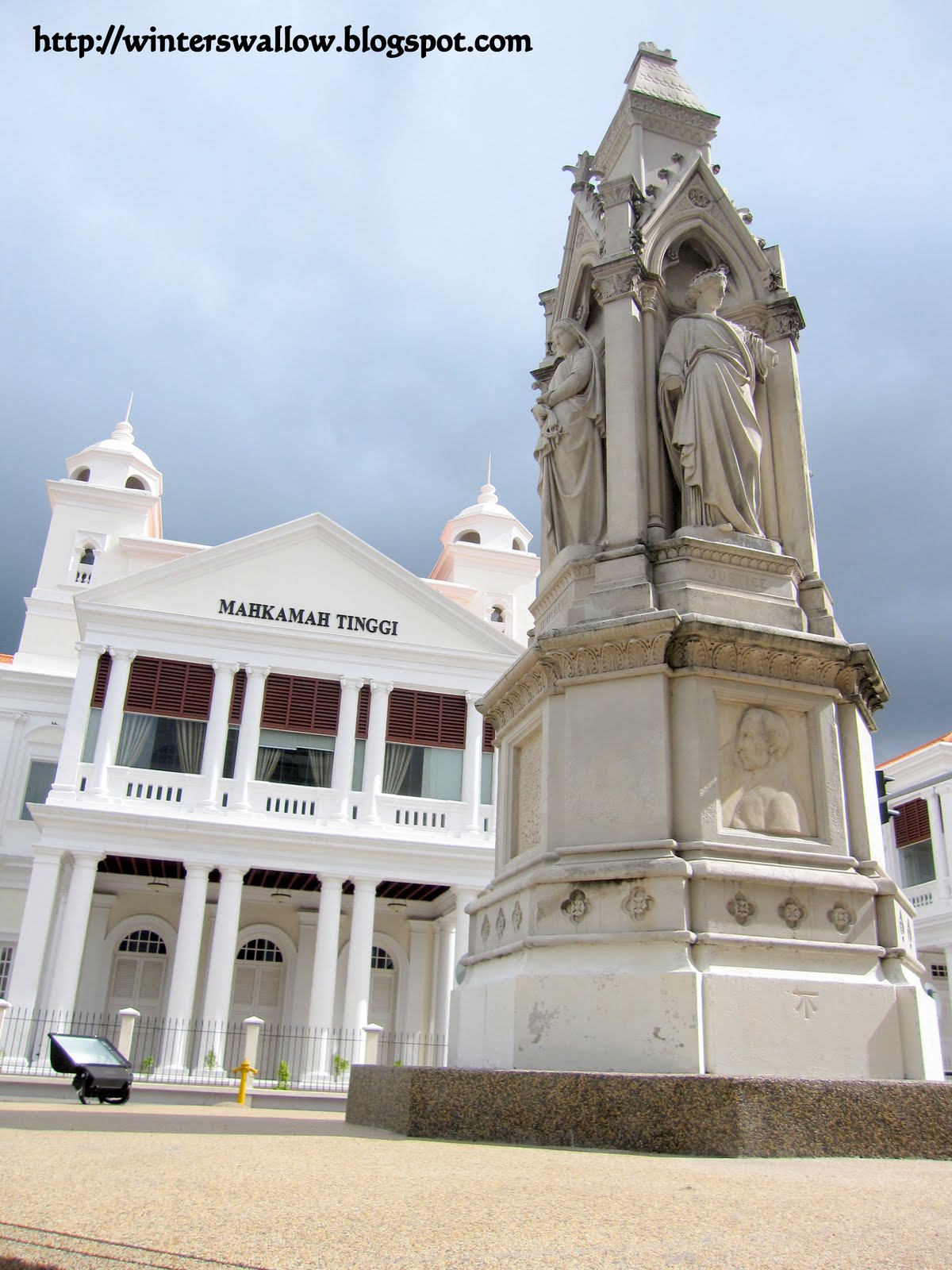
I was gallivanting around Georgetown in Penang and saw this monument in front of the High Court on Lebuh Farquhar.

"Mahkamah Tinggi" is the Bahasa Malaysia word for "High Court"


It's called the Logan Memorial, named after James Richardson Logan, a Scottish lawyer who served in Penang in the 1840s. Here are 2 inscriptions on the monument about Logan.

Some work needs to be done on this inscription.


But that's not what this entry is about.

When I took a closer look at one of the statues on the monument I saw something mindboggling!


The statue is holding something that looks like an Egyptian Ankh !!!!!!!!!


An ankh is an ancient Egyptian hieroglyphic character that means "eternal life".

It can be found in in almost every part of Egypt especially in the magnificent temples in the Valley of the Kings in Luxor.

Karnak Temple in Luxor


Habu Temple in Valley of the Kings.


Temple of Hatshepsut in Valley of the Kings. Somebody must have applied blusher on this statue.


Habu Temple in Valley of the Kings. Can you spot all the ankhs on the front pillar?


So why is the Egyptian symbol of eternal life doing on an English oriented statue in Penang?

You may be thinking what's the big deal? One of my friends said that the person who designed the monument probably added the ankh for fun.

But I'm quite sure this is no coincidence. I'm convinced that there is a connection between the Egyptian ankh and James Richardson Logan.

So many questions went on in my head:
  1. Does the ankh symbolise something that has something to do with the law since the memorial is named after Logan who is a lawyer?
  2. What's the connection between Logan and the ankh? Was he an Egyptologist or someone with a huge interest in Egypt?
Suddenly I felt like Indiana Jones.

So I did some snooping around in cyberspace, and found this bit of information:

"E. A. Wallis Budge postulated that the symbol originated as the belt-buckle of the mother goddess Isis, an idea joined by Wolfhart Westendorf with the notion that both the ankh and the knot of Isis were used as ties on ceremonial girdles.

In their 2004 book The Quick and the Dead, Andrew Hunt Gordon and Calvin W. Schwabe speculated that the ankh, djed, and was symbols have a biological basis derived from ancient cattle culture (linked to the Egyptian belief that semen was created in the spine), thus: 
  • the Ankh, symbol of life, thoracic vertebra of a bull (seen in cross section)
  • the Djed, symbol of stability, base on sacrum of a bull's spine
  • the Was, symbol of power and dominion, a staff featuring the head and tail of the god Set, "great of strength"
Based on the key phrases I've highlighted in red above, take a look at the statue again:


Don't you think the ankh that the statue is holding looks like a thoracic vertebrae of a bull tied to a belt buckle? And the fact that the statue is holding it near her waist gives an indication that it's a girdle?

Therefore the statue must be Isis, a goddess in ancient Egyptian beliefs, which proves my guess that what she's holding is indeed the Egyptian ankh.

So from my observation of the ankh, Isis has now come into the picture. But why is Isis looking like a Mat Salleh (Caucasian) woman instead of an Egyptian goddess?

This mystery is getting more interesting ...

I searched further in cyberspace and it's mentioned that the worship of Isis spread throughout the Greco-Roman world after Alexander the Great conquered Egypt.

I gather that the people in the Greco-Roman world may have remodeled the original Egyptian goddess looking statues of Isis to look more Mat Salleh so that it would be easier for them to relate to her.

In the Egyptian Book of Death, Isis was also known as:
  • she who seeks justice for the poor people
  • she who seeks shelter for the weak people
  • she who seeks righteousness in her people
Since this Logan Memorial was built in honour of James Richardson Logan who is a Scottish lawyer, it would make sense to use the Mat Salleh statue version of Isis to symbolise the above 3 causes. After all, the law is about seeking justice and righteousness.

I am now convinced that the statue in the Logan Memorial is indeed the statue of Isis holding an ankh.

But who would imagine Isis, an Egyptian goddess and the ankh, an ancient Egyptian hieroglyphic character finding its way across the oceans and sands of time to the island of Penang.

Fascinating, isn't it?

The Logan Memorial made my trip to Penang as fascinating as my trip to Egypt.


 Note: The opinions in this blog entry is solely my own and has no connection with any existing report or findings.


Friday, 3 July 2009

Transformers - Less Than Meets The Eye


I managed to get not-so-great seats to watch Transformers 2: Revenge of the Fallen at GSC Pavilion last Wednesday.

After controlling my bladder throughout the 2.5 hour movie because I didn't want to miss a single scene, these are my comments about the movie.

Complicated Visuals
I can’t see where Optimus Prime’s eyes, nose, mouth and body parts are because the visuals are too complicated and the scenes changed too fast.

Keep things simple, man!

Steps to Transform
How many steps does it take for an Autobot or Decepticon to transform?

From the Transformers: Generation 1 cartoon series (my fav), my guess is an average of 5 steps.

In Michael Bay’s life-action version, I think it's an average of 10 steps. Ten steps to me is one step too many. By the time an Autobot transformed, the Decepticon would have whipped his arse.

Confusing Battle Scenes
During the battle scenes, I couldn't tell an Autobot apart from a Decepticon. This is because the movie was too fast moving.

Now I know why my sister's friend watched the movie 4 times.

Egypt
Did you know that for the Egypt scenes, the movie was shot in Cairo and Luxor (about 325 km apart), but made to look like it all happened at the Pyramids in Cairo?

I know cause I recognised the places, having been to Egypt a couple of years back.

I don't know bout you, but I don't like watching movies where the location is distorted.

It's like when Hollywood conveniently placed the Petronas Twin Towers along the Malacca river in the 1999 movie, Entrapment. How Malaysians crinched at that.

Now all the poor Transformers fans are going to visit the Pyramids in Cairo hoping to see the temples in the Valley of the King which are actually located in Luxor.

Autobots Battle Decepticons in Kuala Lumpur
If there is gonna be a third Transformers movie, I hope Michael Bay would consider using KL as one of the locations.

Imagine Optimus Prime shooting the crap out of Megatron while partially destroying the Petronas Twin Towers. Imagine Autobots engaging in gunfire with Decepticons on Jalan Ampang. Wouldn’t that be nice for a change?

I hope ...

Note: Julie has been a Transformers fan ever since she was a kid growing up in the 80’s. Optimus Prime and Bumblebee kept her entertained every week while mum took care of younger sister.

Friday, 13 March 2009

As Big as Ramesses the Great

When I was in Egypt in February 2008, I told myself that I had reached an age where I should start collecting some serious stuff from my travels.

I was sick and tired of t-shirts which will whither away after a few washes and small insignificant decorations that will eventually end up at the Cash Convertors store.

I wanted something authentically Egyptian that will stand the test of time like the pyramids; something that I could pass on to my children's children. So I decided on a papyrus painting.

To find a papyrus painting in Egypt is easy, finding an authentic one made of real papyrus and not banana leaves is difficult.

So I made my way to the Khan El-Khalili bazaar in Cairo.

The market is believed to date back to 1382, making it one of the oldest bazaars in the world.

Having visited the Abu Simbel temple in Aswan,

and falling in love with Ramesses II, I decided that I wanted a painting of Ramesses II because Ramesses II is Ramesses the Great!

When I was in Egypt I noticed that amongst the pharaohs, it's always a popularity contest between Ramesses II and Tutankhamun. Most Egyptian paintings and artwork bear the face of either one of these guys.

Many people like Tutankhamun for various reasons. Essentially he was a boy-king made famous because his tomb was one of the best preserved, not to mention the amount of gold and treasure found in it. Other than that, he was just a small fry, reigned for only 9 years and died at 19 years.

So he didn't really achieve much in his short stint as a pharaoh. Can't blame him though, has anyone achieve great wonders between 10 and 19 years? Heck, I was still climbing trees and playing marbles at that age.

Tutankhamun is obviously shadowed by Ramesses II who is often regarded as Egypt's greatest, most celebrated and most powerful pharaoh. He became pharaoh in his early 20s and reigned for 66 years.

Ramesses II was a warrior and a builder. He lead many expeditions and battles to victory and died at around age 90, leaving behind many temples that has stood the test of time as a testament to his glory.

Ramesses II was also a sifu in fathering capabilities - he fathered approximately 44-56 sons and 40-44 daughters. That's a stud in my books!

So give me a man anytime!

Now back to my papyrus buying story ... At the papyrus shop in Khan Al-Khalili, I told the man to show me all his paintings on Ramesses II. After looking and thinking and choosing, I finally decided on a big painting. You see, size matters with Ramesses II, just look at the temples he built - Abu Simbel in Aswan

and Karnak Temple in Luxor.

Size does matter to Ramesses II so my papyrus had to be big also.

I brought the papyrus back to my family house and my mum helped bring it to the shop for framing. After that it was sitting in my room for the past one year because I didn't have a vehicle big enough to ferry the painting to my apartment.

Finally after 1 year, I asked my uncle who has a Toyota Avanza to bring the painting to my apartment and he did. God bless him!

So here is my 'Ramesses II' now hanging proudly on my living room wall:


Sorry for the poor quality photo. Because of the glass that reflected light and made an ugly white patch in the pic, I had to snap the pic at an angle, hence the ugly pic.

Essentally the painting is made up of 3 main events in Ramesses II's life. The picture on the extreme left is Ramesses II offering gifts to the goddess Isis. The middle pic is Ramesses II in action on his chariot with bow and arrow at the Battle at Kadesh and the last pic is Ramesses II's coronation.

No wonder Ramesses II is also known as Ramesses the Great.

Friday, 25 July 2008

5,000 Years of Civilisation


In February this year I went on a 2-week backpack trip to Egypt alone. Most people told me I'm crazy to do that, especially being a solo female traveller in the Middle East.

But sometimes in life I've gotta do crazy stuffs so that when I look back I won't regret not doing the things I really wanted to do.

This entry chronicles highlights of my journey in Egypt. If I attempt to put in every single place I visited, there won't be enough MBs. So here goes ...

My journey in the Land of the Pharaohs began in Luxor, home to Tutankhamen's tomb in the Valley of the Kings.


After having a jolly good time visiting tombs, temples, museums and listening to the amazing stories of the pharaohs and queens, I took the train down south to Aswan, where the majestic Temple of Abu Simbel stands.


I was lucky to be at Abu Simbel for the Coronation of Ramses II which happens only twice a year - 22 Feb and 22 Oct. On these two dates, the sunrays will illuminate the honoured deities of the temple: Ptah, Re-Harakhty, Amun-Re and Ramses II himself.

After that unforgetable visit, I hopped onto the train heading north to Cairo to visit the Pyramids and the famous Egyptian Museum which houses the treasures of Tutankhamen.


The Egyptian Museum


In Cairo I also experienced a deep presence of Christ in Old Cairo ...


... watched sufi dancing in Islamic Cairo ...


... and went for a bout of shopping at Khan Al-Khalili.


From Cairo, I managed to squeeze in a day-trip to breezy Alexandria, before heading back to Luxor for my flight to KL.

Bibliotheca Alexandrina in Alexandria

Egypt is an easy country to navigate - all its famous places are situated along the Nile, and easily reachable by train or bus. My only regret is that I did not climb Mount Sinai due to time constraints. Mount Sinai is where Moses received the 10 Commandments. Should have been an awesome adventure but obviously I cannot cover an entire country in 2-weeks!

My word of advice for those planning to visit this marvellous country:
Don't visit Egypt for its luscious landscape or good food, because there ain't any. Instead, visit Egypt for its friendly people, rich culture and mystical wonders of its amazing history!


Related Posts Plugin for WordPress, Blogger...