Tuesday, 3 November 2015

Orangutans, Proboscis Monkeys and Sun Bears

During the Eid holidays in July, LvH and I made a weekend trip to Sandakan. Our mission: To visit the Sepilok Orangutan Rehabilitation Centre, the Labuk Bay Proboscis Monkey Sanctuary and the Bornean Sun Bear Conservation Centre.

From Kuala Lumpur, we flew to Sandakan in the state of Sarawak and stayed at Four Points by Sheraton because the company that LvH works for has a corporate rate there.

This is a lovely hotel with sea frontage. While having breakfast on our last morning there, we saw navy ships and air force fighter jets patrolling the area. It was something I've never seen before. I didn't snap any photos because I was enjoying the moment. 


For a traveller, taking a taxi seems to be the most convenient way to move around in Sandakan.

I didn't even bother to find out how to get around by bus because it seems like buses were non existent or extremely infrequent in Sandakan. I think that's why almost every local has their own mode of transportation to get around.

There are taxis waiting outside the hotel and the drivers follow these fares religiously: 


For convenience sake, we booked a taxi for the whole day to take us from the hotel to the 3 places, i.e. (in choronological order) Sepilok Orangutan Rehabilitation Centre, Labuk Bay Proboscis Monkey Sanctuary and The Bornean Sun Bear Conservation Centre (located beside the Sepilok Orang Utan Centre).

According to the driver, we need to visit those places during the feeding times because that's when we'll be able to see the animals. 

So the best itinerary would be to head to Sepilok first thing in the morning to catch the 10.00am feeding time. After that drive to Labuk Bay Proboscis Monkey Sanctuary for the 11.30am feeding and then back to Sepilok to visit The Bornean Sun Bear Conservation Centre (no specific feeding time).

Sepilok Orangutan Rehabilitation Centre

We reached the centre at approximately 9.30am just in time for the 10.00am feeding time.


Before entering the centre, all visitors must keep their bags in the lockers provided (maybe it's to prevent any crazy visitors from kidnapping any baby orangutans!).

These are the entrance fees to the centre:

I let LvH bring his camera into the centre and I kept mine in the locker. The only camera I had on me was my mobile phone.


Feeding times are at 10,00am and 3.00pm daily. It's important to take note because you'll need to arrange your visit according to the feeding times.


As you can see from the photo just above this text, visitors gather at the feeding platform to view the primates partaking in their food. 

The crowd was considerably large that day. Maybe because it was the long Eid holidays.


When the caretaker started dishing out the food on the feeding platform, it took some time for these shy primates to make their appearance. But soon the orangutans started emerging from the forest one by one. Some of them looked hesitant and unsure at first. But soon they started partaking in the spread of fruits, vegetables and milk.


I was rather disappointed that only a handful of them came to the feeding platform that day. Later the taxi driver informed us that not many orangutans could be seen during that time (July) because it's the dry season when flowers are abundant in the forest which translates to an adundance of fruits too. So these orangutans have a wide variety of fruits to choose from in the jungle. 

It is only when food is scarce in the jungle that the orangutans come to the centre regularly for their meals. And this is usually during the rainy season at the end of the year. So take note if you want to see orangutans appear by the dozens at the feeding platform.


This brochure contains all the essential information like getting to the sanctuary, entrance fee, viewing time, etc. 


Entrance fee to the sanctuary is relatively high, especially for non-residents. Someone told us that the high prices is because the sanctuary is owned and managed by a private company and therefore there are no subsidies like in a government organisation.

I was telling LvH that with these entrance fees, the sanctuary better be serving the monkeys food equivalent to the standards of caviar, truffle and wagyu beef - the three most expensive food in the world.

From Sepilok, it took us approximately 40 minutes to get to Labuk Bay by car. We made it for the 11.30am feeding time on Platform B. There are 2 feeding platforms hosting different feeding times. 


During the feeding, the keeper brought fruits and vegetables to the platform where the monkeys stomp down the wooden platforms for their meals.


These monkeys come in all shapes and sizes. Some of the female come carrying their babies around their bellies. The bigger ones are usually the male. Some of them end up fighting with each other over the food.


What makes these monkeys fascinating is that their large noses make them look like humans, including their ...


The sanctuary is not only home to proboscis monkeys but other animals as well:

We were lucky to see a trio of hornbills in the trees. Reminded me of the movie animation, Rio, except that these birds didn't do the samba :-)


After watching the proboscis monkeys at Labuk Bay, the driver took us to the Bornean Sun Bear Conservation Centre (BSBCC) which is located opposite the Sepilok Orangutan Rehabilitation Centre.

Opening hours and entrance fees can be obtained here. There are no specific feeding times so you can just walk in and view the bears in their habitat. According to the BSBCC website, there are about 35 sun bears at the centre. 

I've always had a fascination for sun bears after watching a bunch of these cute fellas dancing in their pen (don't know whether that's the right word) at the Air Keroh Zoo in Malacca many years ago. 

"No, I'm not having a hangover. I'm just hanging out."


According to the BSBCC website, the main threats of the sun bear are deforestation, commercial hunting and pet trade. These bears are often found in appallaing conditions, without a home, a mother, or left to rot in tiny cages. Reading about all these makes me sad.

After visiting the orang utans and sun bears, LvH and I were talking about adopting either an orang utan or a sun bear. LvH said we should name it Lima which is a combination of both our family names. I thought that was a brilliant name!

Day Trip

It's possible to visit these 3 centres in a day trip from Kuala Lumpur. Take the first flight in the morning to Sandakan. Upon arrival head straight to Sepilok, followed by Labuk Bay and BSBCC. In the evening, take your flight back to Kuala Lumpur.

The only thing about this method is that you'll need to make prior arrangements for a car to wait for you at the airport. A day trip may be tiring but you would save on lodging costs and time.


Thursday, 24 September 2015

Tulipomania at the Tesselaar Tulip Festival

I visited the Tesselaar Tulip Festival during my recent trip to Australia.


You may wondering why I chose to visit a tulip festival in Australia which is not known for its tulips. The reason is because I've never seen a tulip in real life (how sad is that). And I don't know when I'll be able to visit The Netherlands.

Anyway, back to the story.

The Tesselaar Tulip Festival is located in the town of Silvan which is about an hour drive from Mount Waverly in Melbourne where I was staying with my aunt. It was a pleasant drive as we had to pass Mount Dandenong area to get to the farm.

Entrance to the festival is UD24.00 for adults.


So what do you get to see for AUD24.00?

First thing that caught my eye were these cute alpacas, which, according to Wikipedia, is a domesticated species of South American camelid.

These alpacas look like miniature llamas to me. Can they dance salsa since they come from South America? ;-) 


It's a pity the tulips were not in full bloom when we were there.


My aunt said that the tulips would have been in full bloom the following week, which by then I would already be back in KL.

Looks like I have to make a trip to Keukenkof in The Netherlands if I want to see tulips in all its glory.

Despite a lack of blooms at the festival, there were a variety of tulips including this one called Malaysia:

 I wonder what the colour of Malaysia will be.


They even have a tulip named after my mum's dog:

Of course Rambo is also the movie character made popular by Sylvester Stallone.


Do you know that tulips originated from Turkey? Don't believe me? Read here:


According to the Tesselaar Tulip Festival broucher, Turkey hosted the world's first Tulip Festival more than 400 years ago.

Soon the Dutch brought the flower to greater heights and now everyone thinks tulips originated from The Netherlands. Interestingly, the Tesselaar Tulip Farm were founded by Dutch couple, Cees and Johanna Tesselaar who left Holland on their wedding day in 1939 and headed to Australia with one suitcase. Today the farm is a family business into its third generation. Trust the Dutch to popularise the tulip wherever they go.

First time seeing a boot scraper:


They probably put up this signage because there were people from China around:


I like that the organisers had placed sculptures amongst the tulips like this:

I guess it's mandatory to have a windmill at a tulip festival.


Reminded me of the legendary Steve McQueen, go figure.


Looks like a Proton Wira sedan.


Of course they had to put kangaroo sculptures too.


This is my favourite sculpture:

I would have bought this if I had a big garden or space at home.


To those who were unable to drag themselves across the 25-acre tulip farm, this mode of transportation is a good option:

Not sure whether there's a fee to get onto this tram.


You can buy tulip bulbs from the Tulip Station:

If only tulips are able to grow in tropical climate, I would have bought some home.


What would a festival be without souvenir shops:

The young lady in the shop was wearing a traditional Dutch costume. Too bad I didn't take a photo of her. 


They were selling all sorts of souvenirs from The Netherlands:

So preeeeeeeetty ... Now must wait for LvH to balik kampung so that I can ask him to get me a porcelain windmill.


There were shops to give the festival a Dutch flavour:


Dutch food were also on sale:

This is called poffertjes. My sister says it looks like kuih cara from Malaysia. From this, I deduce the Dutch must have adopted this recipe from Malaysia when they colonised the land in 1641. Or they could have taken the recipe from Indonesia when they were rulers there between the late 1800s - mid 1900s. Malaysia and Indonesia share similarities in their food and culture.


Not forgetting that tulips originated from Turkey, there were Turkish stalls and souvenirs on sale:

I like the riot of colours here.


A band was belting out Turkish songs on the Holland Stage:

I think water got into my lenses.


This is the 62nd year of the Tesselaar Tulip Festival and the organisers had planned different themes for each week like Turkish Weekend, Yarra Ranges Week and Food Wine & Jazz Weekend till the festival ends on 1 October 2015.

If I had stayed longer in Australia, I would have visited the festival a little later when there would have been more blooming tulips and maybe join the Dutch Weekend too.

Now I'll have to make a trip to The Netherlands for some real tulipomania, but it's so 'painful' these days to travel to Europe now that the value of the Malaysian Ringgit have fallen significantly. But at least I can now say that I've seen a tulip in real life, all at the Tesselaar Tulip Festival.


Thursday, 6 August 2015

The Magnificent Shwedagon Pagoda


If you visit Yangon in Myanmar, make sure you visit its famous Shwedagon Pagoda. To date, it is the most magnificent temple I've visited. It even eclipses the temples of Thailand.

We left Sleep In Hostel that morning after a hearty breakfast and started our walk to look for Shwedagon Pagoda.

Sleep In Hostel is located in an alley in Chinatown which is a superb location near shops and hawker stalls. Can you spot the hostel's red signage in this pic?


After lotsa walking, detours and getting lost, we arrived at a park which was opposite Shwedagon Pagoda.

We saw this plane in the park:

Who could resist a plane in a park. So we took a closer look at the plane and exploring its tyres, propeller, wings, etc. We even tried to climb inside the plane but its doors were locked.


Soon our stomachs were screaming 'hunger!'. So we stopped at one of the stalls in the park for lunch:

 I learned how to make the onion salad in the pic. Method: Slice an onion and rub salt all over. Then squeeze lime or lemon juice over it. This salad makes a simple rice dish taste so appetising. 


While having lunch the heavens opened and it started raining cats and dogs:

We visited Yangon in July which was during the rainy season and it was raining almost everyday. Sometimes the rains can be pretty fierce.


After waiting for about 1.5 hours, the fierce rains reduced its fury into a drizzle. Then we decided to make a run to the pagoda entrance. 

There were two huge statues at the entrance that looked like Fu dogs to me. They were huge mothers and now I'm regretting that I didn't snap pics of those dogs.

Entry into Shwedagon Pagoda is 8,000 Kyat:


We removed our shoes and left them at the entrance. All visitors must go into the pagoda barefooted. Socks are not allowed too. Yikes.

The walk to the main pagoda complex was an interesting one as we had to pass an escalator:

First time in my life I'm seeing an escalator in a pagoda. See what I told you about socks and shoes not allowed in the pagoda ...


The sheer size of its halls was enough to make me wonder how the main building would look like:

 That's Angie trying to snap a pic of the hall.


Soon we reached the main complex and I was amazed at its beauty.

As it was raining, monks and visitors walked on the green tarpaulin to avoid falling down on the slippery marble floors.


Angie mentioned that since socks and shoes are not allowed inside, it was probably a good idea to visit the pagoda during the rainy season as all dirt and animal faeces (temples/pagodas in Myanmar are full of these) are washed away easily.

Just imagine if we had visited Shwedagon Pagoda or Myanmar for that matter during the dry season. Our feet would be covered with faeces after each visit to a temple/pagoda. 


I was standing here marvelling at the stupas when I saw a family struggling with their irritated child. The child was not used going barefeet and getting his feet wet. So he refused to walk and wanted to be carried instead. Sometimes this is a reason not to have kids.


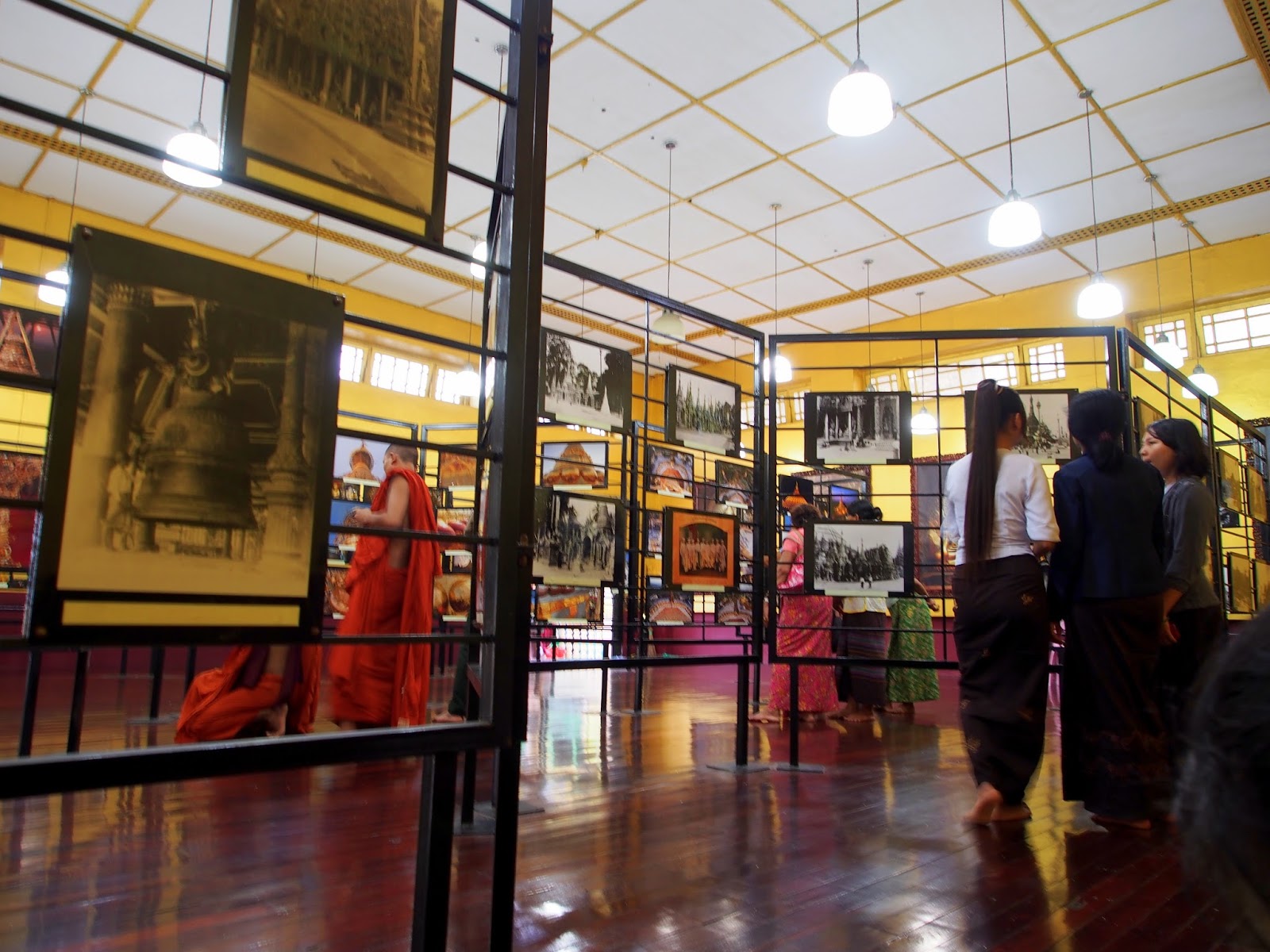
After walking around we entered a small building where there was an exhibition on Shwedagon Pagoda:

We sat down on the timber floors to rest our weary legs.


The down part about visiting Yangon during the rainy season is that it was difficult to snap pics as I was afraid to bring my camera out in case it gets wet. And that is why I don't have more pics of this marvellous pagoda to share with you. But do visit Shwedagon Pagoda if you're in Yangon, you won't be disappointed.


Related Posts Plugin for WordPress, Blogger...